Check you can trust the scores
Read the agreement figures for your own workspace before you act on a score.
Use this before you tell somebody their agent scores 71, so you know what that number can carry.
Open Scoring quality in the left rail.
Its opening line says how many of your team's verdicts we matched.
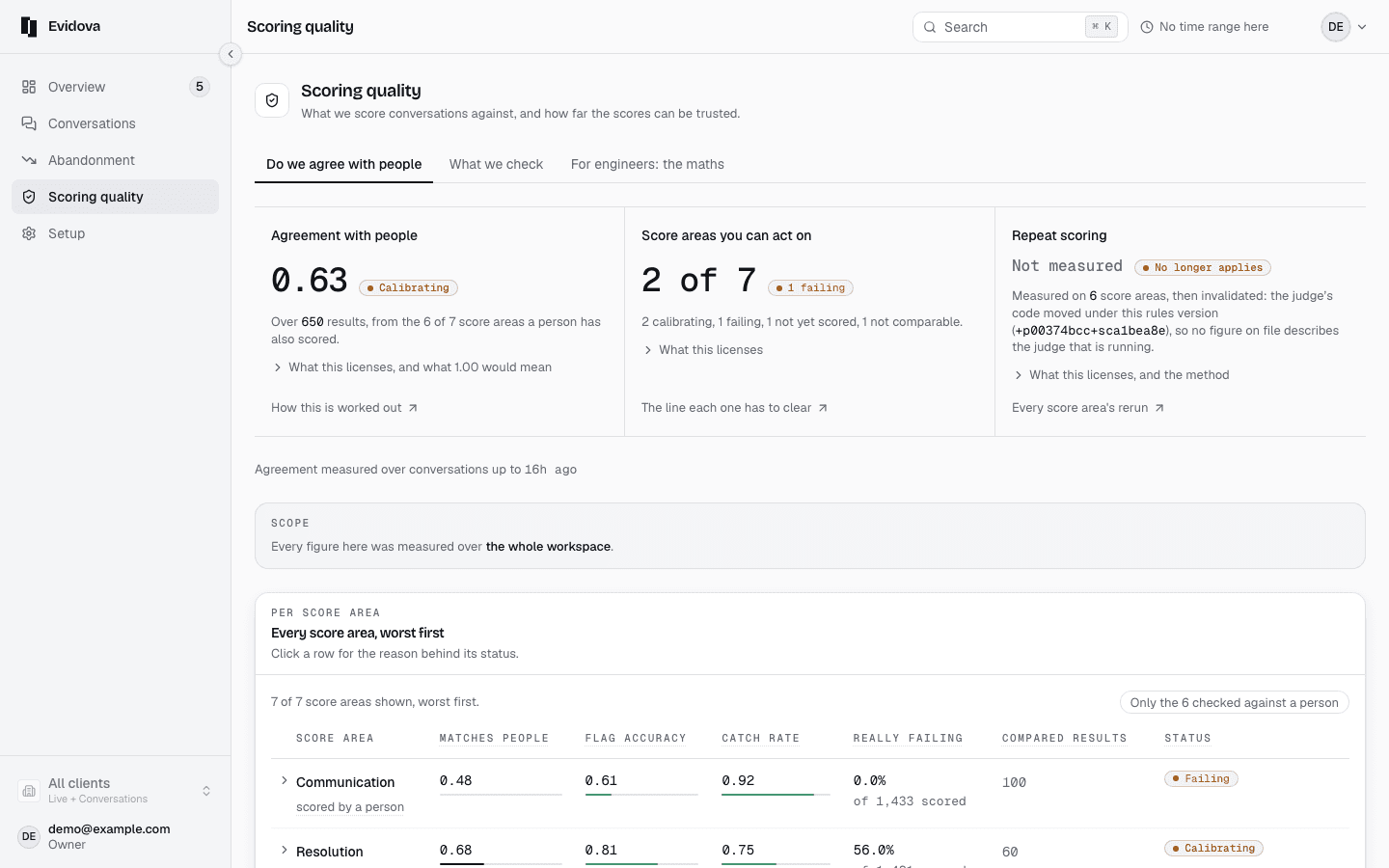
Read the five cards across the top.
Read the square under them.
Each cell is one of the four things that can happen to a verdict.
Read the newest verdicts we got wrong.
Each one carries the reason the reviewer wrote.
Press Read it on one, or Change the rule.
Read By score area, weakest first.
Read the How we decide column.
A model decides the area, a stopwatch does, or no live rule reaches it.
Press Open on a row, or Read more.
Read more appears where too few verdicts sit beside ours to compare.
Press For engineers, or Download the method.
The working behind every figure on the screen.
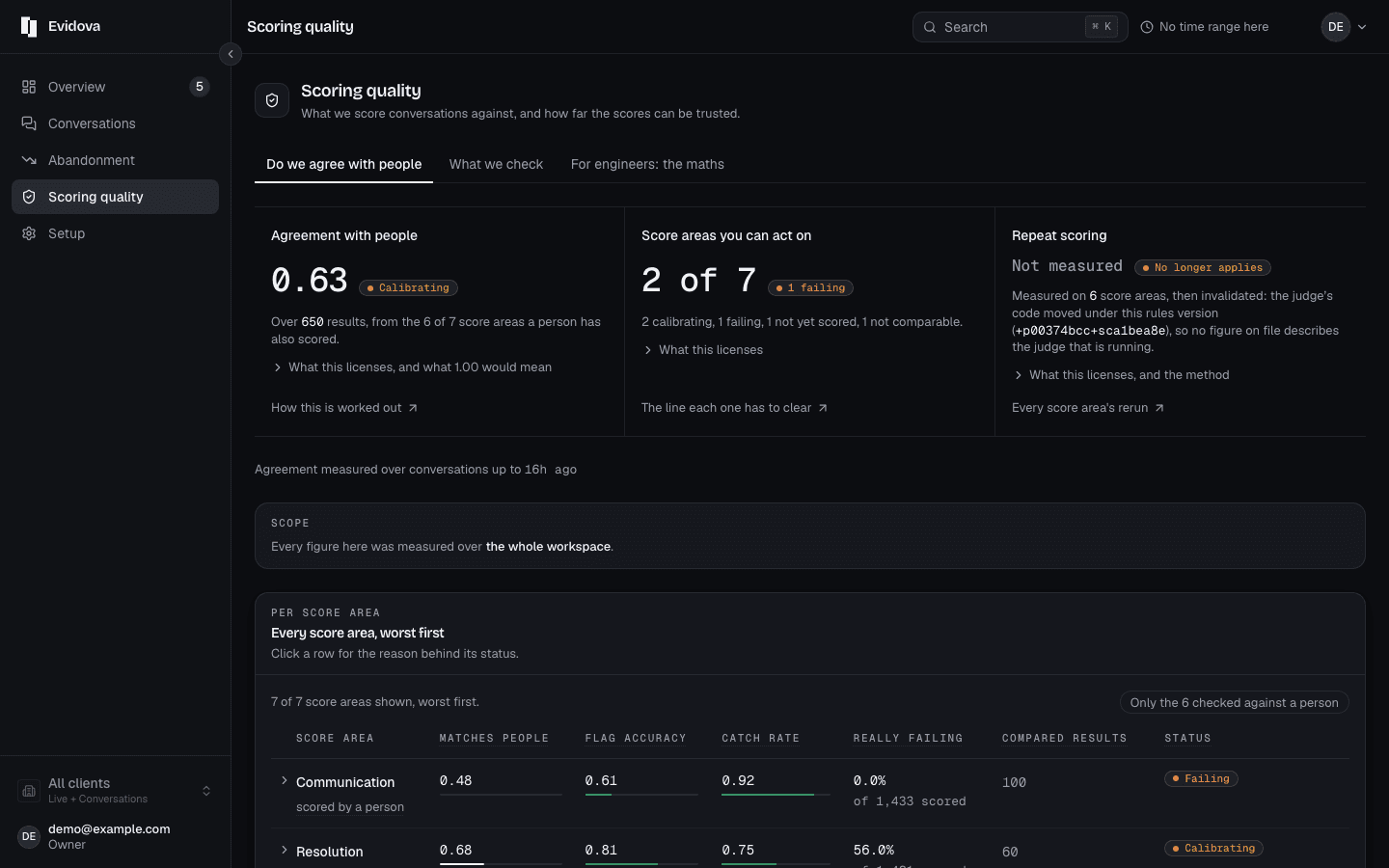
What the five cards mean
| How much we looked at | The share of finished conversations that carry a score |
|---|---|
| We matched your team | How often we landed where your own reviewers landed |
| What the real failure rate is | A range, corrected for our own known mistakes |
| Your own reviewers agreed with each other | Whether two of your people who read the same rule landed together |
| Same conversation scored twice | How far a score moves when nothing about the conversation changed |
| A blank in the table | Not measured. Never zero |
Reading it right
- Act on an area that matched a person often and has enough read by a person behind it. An area with too few says so rather than showing a number.
- Same conversation scored twice is your floor for change. A move smaller than that figure is not movement.
- If an area you need is unmeasured, the fix is examples. Record Agree or Disagree as you read conversations.
Read next
- Investigate one conversation · Open a single conversation and see which turn broke which rule, and why.
- Add a rule of your own · Write a question you want asked of every conversation, and put it live.
- Approve a suggested rule · Review a rule we drafted from your own documents before it counts.